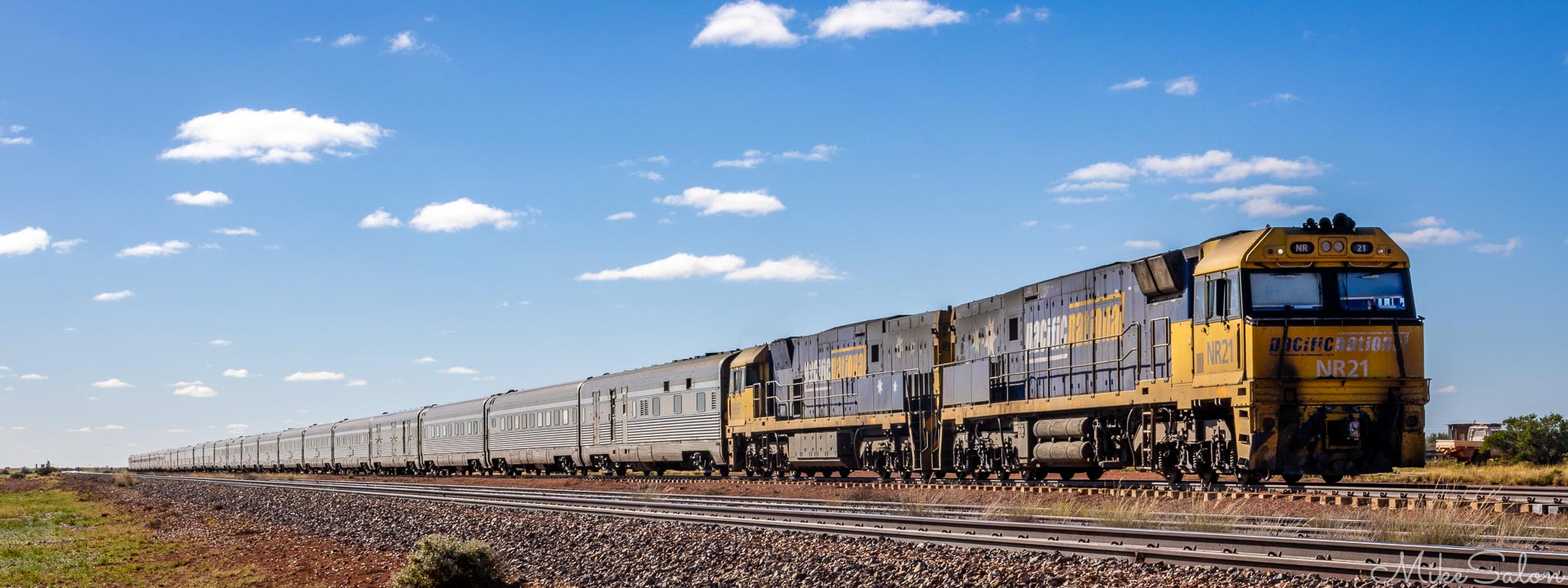
Every Ghan passenger seems to come home with this photograph. The train pauses long enough at Coober Pedy for hundreds of cameras to converge on exactly the same patch of outback dirt, waiting for the locomotives to line up in the sunshine. Sometimes clichés become clichés because they are simply too good to ignore. [1241]

mike salon`s

The Ghan Southbound
Darwin to Adelaide...

Every Ghan passenger seems to come home with this photograph. The train pauses long enough at Coober Pedy for hundreds of cameras to converge on exactly the same patch of outback dirt, waiting for the locomotives to line up in the sunshine. Sometimes clichés become clichés because they are simply too good to ignore. [1241]

The Ghan is one of those journeys that feels less like mere transport and more like a slow, luxurious thread stitching together the heart of Australia. Just as well, because it costs real money to ride this train! Afghan cameleers' endurance and knowledge of desert travel gave the line its name, and their legacy still feels present as the train rolls south from the tropics into the red centre. We travelled from north to south, just under 3000km in total: our train was 700m long and had 22 passenger carriages, each branded with the train name, and there would not be a passenger who did not have a selfie taken in front of these unforgettable logos!

The railway itself has been rebuilt, rerouted and reimagined over the decades, shifting from a rattling narrow-gauge line prone to washouts to the modern, steel-straight track that now carries The Ghan's long silver carriages. What was once a tough, practical link between remote settlements has become a comfortable passage through landscapes that change hour by hour: wetlands, escarpments, spinifex plains, salt lakes and finally the wide, pale deserts edging South Australia.

Today's Ghan travels at up to 120km/hr, rather frustrating any attempts at photography. But it pauses not just for refuelling and rewatering but for a range of optional half and full day off-train "experiences" that break the rhythm of the rails and extend the duration of the journey. These make the trip (and are, in fact, the reason we took it at all, although some passengers were primarily on board for the food and wine!). But being "on" a train prevents you from taking photos from "off" the train, except at stops.

With that trip behind us, we have a sense of having crossed something vast and beautiful. Our photos cannot do the Australian outback justice, but they will certainly provide a nice memento of the journey.

Darwin, the northern capital...

We flew to Darwin a few days early. After all, you wouldn't want an airline delay to cause you to miss the train's departure. We stayed at the Hilton Darwin, very centrally located and within easy walking distance of most attractions. Darwin feels different from Australia's southern capitals. The climate is tropical, the population is relatively small, and Southeast Asia feels closer both geographically and culturally than Sydney or Melbourne. Yet for all its laid-back character, the city has had a turbulent history. The Darwin CBD is really an extensive memorial to two well known but catastrophic events, the Japanese bombing in 1942 For the Bombing of Darwin, see Wikipedia. which killed ~250 people, and Cyclone Tracy in 1974 For Cyclone Tracy, see Wikipedia. which caused 66 deaths and destroyed 80% of the city. The result is a city where much of the architecture is comparatively modern, not by choice but by necessity.

As on previous trips to Darwin, I considered visiting the Tiwi Islands. However, the information I found seemed to focus on organised tours, permits and managed activities rather than independent exploration. That's entirely understandable given the islands' unique status, but I generally prefer destinations where I can simply wander around with a camera and see what I discover. Whether my impression was fair or not, it was enough to dampen my enthusiasm, and a Tiwi Islands visit has never made it into final itineraries.

All aboard!...

As it happened, we were on-time but the train was late. The national Testra Outage delayed the northbound departure of The Ghan from Adelaide by a full day. But our departure southbound (of the same physical train) was only two hours late. Congratulations to Journey Beyond for managing to minimise the disruption for us, but we really don't know how the schedule for the prior northbound trip was rearranged. The passengers must have been furious. Maybe some compensation was paid for the missed night? The train's cabin crew certainly did not get much sleep.

We've been in Darwin several times before over many years. We enjoyed our time in Darwin, not feeling we had to do anything special other than hang out, walk around and catch the free buses to Cullen Bay and the Mindl Night Markets. The weather was fine and hot, obviously, it was good to find suitable drinking holes for cooling beverages. The town is, as it has long been, a huge memorial to the Japanese bombing in WW2, and to Cyclone Tracy which destroyed it at Christmas 1971. Plaques emphasise that Darwin suffered more bombing than Pearl Harbour only weeks before.

A live singer/musician, David Spry See David Spry's website. , entertained us at Darwin's Berrimah terminal, and we boarded The Ghan at about 11:00, and right from the outset, we experienced fabulous personal service. The Ghan is hideously expensive, but they do compensate for that with incredible service. We knew the cabin would be tiny, and our expectations were fully met. We did not have too much carry-on luggage, but the major problem was that there was almost nowhere to put anything down. Our en-suite bathroom was excellent, but again, nowhere to stow sponge bags etc. Our twin seats mysteriously converted themselves to twin beds at dinner time each night. Each Platinum Class carriage has 5 cabins, and we heard that the new "suites" which Journey Beyond is introducing next year are two to a carriage (at over twice the price). A suite may be just the ticket for true, spacious luxury!

We have another suggestion. The Ghan needs an Observation Car. We have trained across Canada on The Canadian and, from Jasper into Vancouver, on the Rocky Mountaineer. Both of these have Observation Cars which many passengers (including us) made good use of, while others were happy to travel in their seats or cabins. These cars are not much good for photography what with optically imperfect and scratched glass, but they sure make absorbing the view a much more fulfilling experience. The Rocky Mountaineer even had open vestibules at the end of some carriages for fresh air fiends and photographers to exploit. Wishful thinking for The Ghan, we fear, and some spoil-sport will probably tell us that our bridges are too low for Observation Cars to fit under!

Katherine`s Outback Experience

Months before we boarded The Ghan, Journey Beyond tempted us the choice of two or three so-called "experiences" (hate that word!) at each stopping place, mostly included in the fare. These are excursions invariably involving coach transits from the railway station. So the photographs we took are of the experiences that we selected. We think we made pretty good choices.

Due to the delayed departure, we were late arriving in the Northern Territory's second city, Katherine but the miracle workers at Journey Beyond manage to adjust the schedules with all their tour providers, because they all went ahead. Having been to Katherine before, our choice was called Katherine Outback Experience (KOE) Webpage for Katherine Outback Experience , a weird name because the visit was actually to what proved to be a working horse stud where also cattle, goats and dogs were trained. This is not a complaint, because the Experience proved to be very entertaining, if not outback. We arrived at the location, about 7km east of town,about 5-10 minutes after the last show of the day had started up.

As the website says, KOE has "real horse training, working dog demonstrations ... Owned by multiple Golden Guitar winner and horseman Tom Curtain, this is a genuine outback experience that is raw, real and unlike anything else in the Territory." This was a very polished performance by Tom and his team. Tom entertained a good crowd (many more than those off the train) with song and guitar as he galloped around the area on a horse, and his antics with working dogs were hilarious.

With the sun setting, our coach headed back to The Ghan for a memorable meal onboard. We saw nothing of the town of Katherine which may have disappointed some, but we, personally, had been there before on our long-ago Gibb River Road camping trip, and had enjoyed a visit to the Gorge.

Alice Springs and its Desert Park...

Alice Springs needs little introduction. Home to about 25,000 people, it is the undisputed capital of Australia's Red Centre and the largest town for hundreds of kilometres in any direction. The town straddles the mostly dry Todd River (named after telegraph pioneer, Sir Charles Todd), whose broad sandy bed spends much of its life waiting for the rare occasions when water actually flows. The town, began as a telegraph station and grew into the administrative, transport and tourism centre of central Australia. For many visitors, this is the place where the outback stops being an abstract concept and becomes something tangible.

Coaches picked us up at the Alice Springs terminal. First up was a drive around the CBD, but such a tour does not count for photographers if you don't/can't get off the bus! What this part of the day cemented in some people's minds is that Alice Springs is a dangerous place for visitors. That was an unfortunate consequence which the organisers could have avoided, but probably time did not allow it. We did get off at the top of Anzac Hill where there is a panoramic views of the town,

Immediately south of The Alice, the Heavitree Range forms a rugged barrier that appears to hem in the town, but in reality, it is pierced by the narrow Heavitree Gap, through which the Todd River, Stuart Highway and Adelaide-Darwin railway all pass. The map is intriguing, with additional ridges, gaps and peaks extending eastwards into the East MacDonnell Ranges. The result is a landscape of long parallel walls of rock separated by broad valleys, a geological structure that has dictated travel routes and settlement patterns for thousands of years. Our lunch stop, known simply as The Old Quarry, which was a destination in itself, took us through that Gap. The Quarry occupies a former site in the ridges south-east of Alice Springs. What was once an industrial operation has been reinvented as an event venue, taking advantage of the very geology that created the quarry in the first place. Surrounded by the rugged folds of the East MacDonnell Ranges, it was a surprisingly atmospheric place for a very pleasant buffet lunch. All groups from The Ghan wound up here for lunch, one after the other, quite clever choreography.

We've been to The Alice a number of times over the years, but never to the Desert Park See more at the Alice Springs Desert Park website, which says that it is "an inspiring portrayal of Australia's central desert environment that seamlessly blends the plants, birds, animals and people of our arid regions within one tourism and conservation facility." so choosing the option which included the Park was a no-brainer, and, on a perfect day, it was truly outstanding. The Park is relatively young, having only opened in 1997, and its 54ha core area is divided into three habitats, Desert Rivers, Sand Country and Woodland. IT is owned by the Northern Territory Government, and the investment here is manifestly substantial. Features which really grabbed my camera were the avian enclosure, the nocturnal house, and a delightful performance by a trainer and various wild birds, certainly trained but not in captivity.

But the day was blessed with yet another memorable highlight, a sunset dinner on a glorious evening at the 1871 Telegraph Station See more at Alice Springs Telegrpah Station website, which says "The Telegraph Station, nestled within the Alice Springs Telegraph Station Historical Reserve, stands as the birthplace of Alice Springs. Established in 1871, it served as a pivotal link along Australia’s Overland Telegraph Line, connecting Darwin and Adelaide. This historic site not only bridged Australia’s population centres but also integrated the continent into the broader telegraph network of the British Empire. Before its construction, messages to England took months via sea voyage, but with the telegraph, communications through Alice Springs could reach London in as little as 5 hours—an astounding feat in the 19th century." which is a location of great historical significance, being where the town began, being where the actual spring is, being a vital link in Australia's early communications with the world, and now being an advanced tourist attraction and function centre. Indeed, the town takes its current name from a permanent waterhole discovered during construction of the Overland Telegraph named after Alice Todd, wife of the above-mentioned Sir Charles Todd. It appears that Mrs. Todd, living in Adelaide, never saw the waterhole, much less the town, named after her by her admirer, her husband's surveyor William Whitfield Mills. One wonders at this relationship!

Coober Pedy, there at last!...

We expected the South Australian opal town Cooper Pedy to be the highlight of our off-train experiences because a visit there has been a bucket-list item for years. Twice we have had to cancel driving trips here (firstly COVID, then flooding) and we figured this was our best way of eventually ticking that box, if only for one day. The Coober Pedy stop was why elected the soutbound Ghan - the norhbound stops elsewhere. We seem fatally attracted to opal mining towns. Years ago we visited Lightning Ridge NSW, and more recently White Cliffs NSW. On a recent birding trip through Channel Country Queensland for only a fleeting visit to Opalton.

As for the experiences choices offered by The Ghan, it was difficult to distinguish between them, and on the day we realised that they were all subtle variations of the same general theme. The railway doesn't go though Cooper Pedy, but our train stopped at Manguri about 40km to the west. Manguri is no more than a siding, a short goods loading platform plus a few relics, all in the middle of a gibber desert. Apart from this and a curious circle of benches where Ghan passengers wait to rejoin the train, there is nothing to suggest any permanent human presence. It is an odd place to begin a visit to one of Australia's most famous outback towns! And if it wasn't for that siding, we guess that The Ghan would not be able to stop there for a whole day. The drive into Coober was in coaches mostly on a corrugated dirt road, and by their reaction, we deduce that some passengers had never been off the bitumen before. Our coach and driver were both up to the job, however.

Coober Pedy is unusual even by Australian standards. Founded after the discovery of opal in 1915, it grew into what is often described as the opal capital of the world, producing a large proportion of the world's precious opals. Faced with summer temperatures that routinely exceed 40°C, many residents responded in the most practical way imaginable: they moved underground. Today, homes, churches, hotels and even shops can be found in "dugouts" excavated beneath the desert surface. The town's name is generally said to derive from the Aboriginal term kupa piti, commonly translated as "whitefella's hole" or "white man's hole in the ground", an apt description of the miners who arrived here in search of fortune and proceeded to pepper the landscape with shafts and excavations. But what it clearly also means is that opals were being hunted (from 1915) before the name was accorded (1920).

Adelaide, the southern capital...

The Ghan pulled into Adelaide Terminal on the fourth morning, we all disembarked and went our various ways. Some were flying home immediately, others spending a few days in Adelaide first. One couple had their own private plane waiting them, it having flown above us, from Darwin! Our plan was Adelaide for a few days, then a driving trip to and around the Fleurieu Peninsula, particularly Goolwa to see the Murray River's mouth to the sea.

Hilton, our usual city hotel choice, has closed its premises in Adelaide since we were here last, so we splurged on the Marriott nearby, on King William St. Nothing bad to say about this upmarket offering. Our bathroom was fabulous, the shower arguably the best ever! We had a wardrobe which was as big as our entire cabin on the train!

Use of Artificial Intelligence

On this and many pages, I freely admit to using AI to identify birds, animals, plants. I claim no expertise in these matters. I suspect that AI is not always correct in its identification either, so if any viewer of these pages knows better, please feel free to put me right. Some of my photos are barely good enough for correct ID! AI is also very useful at suggesting captions to go with many images, because I am also looking for wry commentary, but I edit those suggestions to more closely match my style, or at least, that's my intent.