mikesalon.com
Themes
Heritage And History

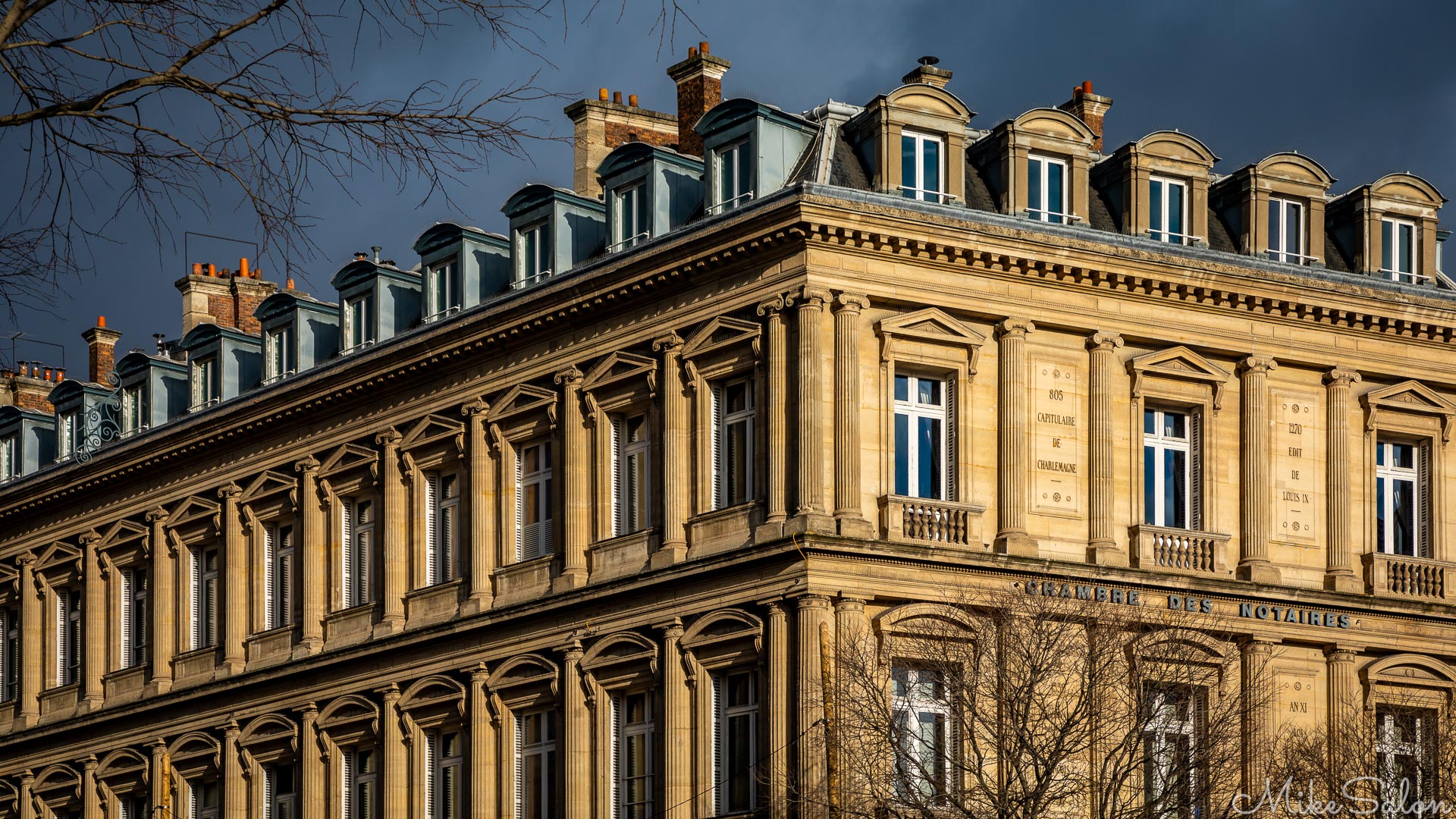
Standing prominently at the Place du Châtelet, the Chambre des Notaires de Paris exhibits classic Hausmannian Neo-Renaissance architecture, designed by architect Jean-Antoine Alavoine and built in 1855 during Haussmann's major renovation of Paris.
The facade prominently features carved panels commemorating pivotal milestones in French legal and notarial history: One marks Charlemagne's imperial decree in 805 directing local officials to appoint scribes to draft contracts and legal deeds, laying the groundwork for the modern civil notary system. The other honors King Louis IX (Saint Louis), who, in 1270, formally established sixty royal notaries attached to the Grand Châtelet, founding the organization that ultimately evolved into today's Parisian notary chamber. Bathed in warm daylight against a backdrop of dark, leaden clouds, the corner facade displays intricate classical details-from tall fluted columns and ornate window moldings to slate mansard dormers-capturing a striking contrast between historic stone and atmospheric sky. [3343]
Heritage and History
Across continents, older buildings carry the weight of time in their stone, timber, and ornament. In photographing them, I’m drawn to the way age settles into façades, how restoration meets weathering, and how civic and domestic histories remain legible in the built form. Whether it’s a colonial streetscape, a European civic building, or a sandstone landmark in Australia, these structures reveal architecture as a record of human continuity — shaped by craft, culture, and the slow accumulation of stories.