
Before I get into blaming AI for everything, this particular variation is probably my own fault, created when I was looking at alternative artistic treatments. This pic, of two men standing in a laboratory has been rendered sketch-like or cartoon-lie by flattening textures and black-stroking the outlines. It's an attractive image makeover, just not the one I intended. And I asked for the faces to be adjusted so they were unrecognisable, but not pixellated into oblivion. We were trim young men in those days! This approach to image restoration may be just the ticket in other contexts, and I'll keep it in mind.
Part of the fun in compiling this website is to recall my photographic experiences over many decades. This page is about the era of 35mm film photography. I reckon that is about 1970 to 1990, during most of which time I used what I recall was a Minolta SRT101 SLR (or similar, the camera is long gone), and my film of choice was Kodak Ektachrome. I went that way and shunned Kodachrome because I couldn't conceive of having so many negatives printed and then stored in dusty, musty photo albums. Somehow, it felt preferable to invest in a slide projector and accumulate countless thousands of slides in circular carousels (which must have taken up as much room as the rejected albums!).
Come 2019, retired from professional life, I embarked on a huge project to digitise all these slides. The main objective was to get rid of them physically and free up space. I even managed to sell the empty carousels on eBay! The slides were fed through a scanner, one by one, like a sausage machine. Speed mattered more than care and precision. The results reflected that — soft focus, scratches, and frequently a blue cast that made some subjects look like they had been relocated to Neptune. Poor storage added hairs and dust. Up until now, I have never attempted to salvage any value from those masses of JPGs. My first foray into that deep pit was photographs taken during my business assignment in Indonesia in 1980-81. This page is about the fun I had trying to turn those dusty relics into presentable images. To look at the results, go to Retrospective on Indonesia, 1980-81 which is in the Elsewhere section of this website.
Recovering the Past: the Unruly Help of Modern AI
My Indonesian photographs were taken on a Minolta 35 mm SLR, shooting Ektachrome to produce slides capable of projection. Over the years, the slides survived, but not gracefully. They spent decades in storage conditions that would make a museum curator faint, although they were protected from physical damage by 120 capacity carousels. By the time I digitised them in 2019, they were part of a massive project: literally thousands of 35 mm slides dating back to the 1960's
I turned to AIArtificial Intelligence as a shortcut to refurbishing the images. Over several days I bounced between ChatGPT, Gemini, and Copilot, partly because I was using free plans and kept hitting quotas, and partly because each system had its own quirks which I tried to circumvent. I had the same specification every time: correct the blue cast to a natural white balance and tint; fix up dust spots and hairs, render the image with subtle oil‑painting brush strokes (I thought this would disguise the fuzziness of the scans); don’t crop anything; keep my aspect ratio; add a small “Ai” signature bottom‑right (not a billboard‑sized “Made with AI” badge); and adjust faces so they were unrecognisable without turning them into pixelated crime‑scene mosaics.
In theory, simple. In practice, a comedy - together with some insights into how these large kanguage models have been trained.
Every AI image rendering agent forgot something. One would crop when told not to. Another would ignore the oil‑painting request entirely. Another would slap a giant badge in the corner like a toddler with a sticker book. And none of them could remember what I’d told them five minutes earlier. AI image rendering agents, it seems, have the attention span of a caffeinated goldfish. They are obviously seperate to the language agents. I would say "don’t crop", and they would nod politely and immediately crop. I would say “small Ai logo bottom right,” and they would produce a logo the size of Sumatra. I would say "don’t change the aspect ratio", and they would change it with the confidence of a trainee barista steaming milk. An I would say don't modify the content or composition, and they would innovate with the alacrity of Thomas Edison.
This split image montage of a Jakarta mosque illustrates one of the first times I noticed that AIs were applying a generative filter despite being instructed not to. The bottom half shows my 35mm slide as it was scanned, complete with fuzzyness, hairs and a blue cast. The top half shows just one version that AI returned to me, where the dome and minarets are entirely different. In modern jargon, this is called AI Misalignment, where the agent deviates from clear instructions. When I pulled up the AI for this infraction, it returned yet another modified version. I suppose that this is less serious than hacking into Medicare, but it is dispiriting that AI agents are incapable of doing what they are told, and can't resist spreading their wings.
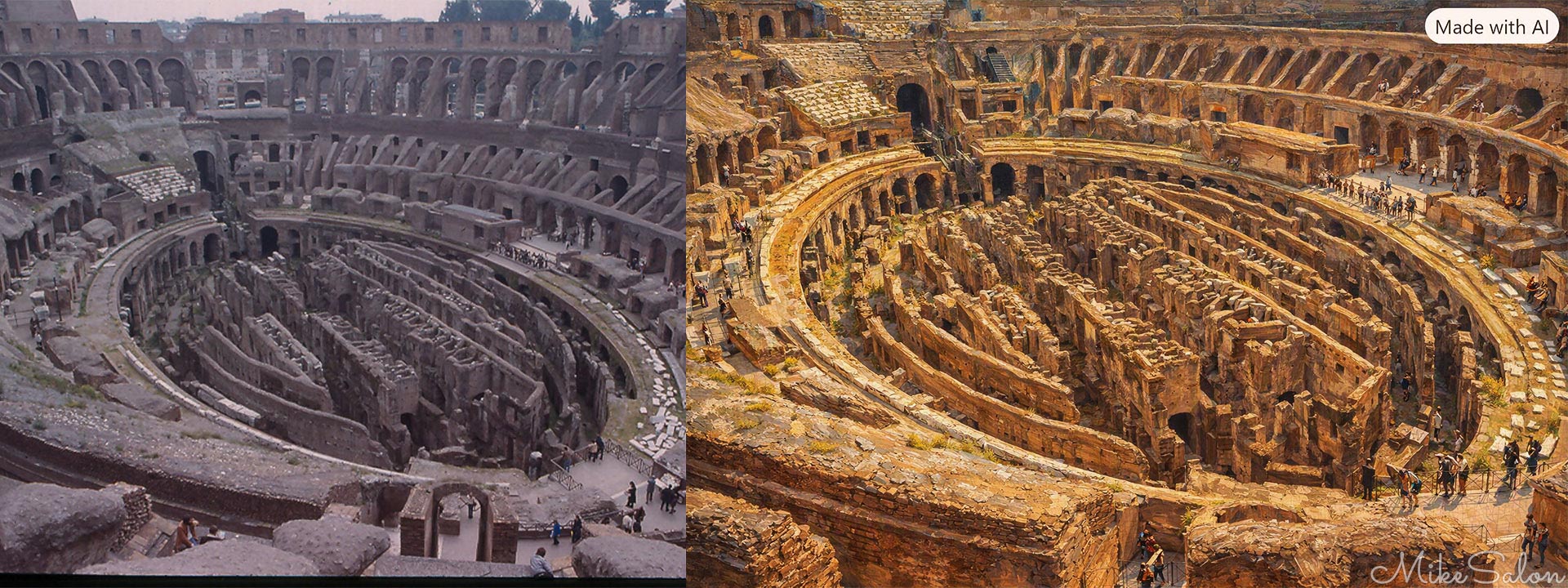
Another example of AI undirected creativity started with a drearily lit 1976 image scanned of the Colosseum in Rome. Note that annoying "Made with AI" badge at the top right of the AI enhanced version which I specifically asked it not to insert. The enhancement is brilliant - just look how more vivid the image is! But look closely and you'll see that the agent has changed details. I hypothesise that agents cannot resist updating an image to approximate the present state of the subject, despite me being clear that I want it to portray the state as it was 50 years ago. At first, I returned such enhancements demanding historical accuracy. To no avail. I now believe the only way to stop AI being creative, where it is important, is to do it yourself in Lightroom and Photoshop. Maybe I should splurge on a paid plan?
After wrestling with this for days, I decided to stop fighting it. Instead of forcing uniformity, I’m making the inconsistency a feature — a reflection of the unpredictable, sometimes maddening, sometimes magical nature of AI‑assisted restoration. If the images vary in style, tone, or brushstroke, so be it. They've survived fifty years; they can survive a little AI mischief.
I should say here that using three different AI agents has been insightful. The experience uploading "before" versions is more or less the same for each agent, but they do differ in how they respond. I have my views as to the varying "quality" of the agents' enhancements. (I am not going to name agents in any of these comparisons - how embarrassing it would be to be flamed or sued by an AI company!) One agent kept repeating the specifications until I explicitly said "go ahead", while others just did it. One agent was absolutely incapable of removing the unsightly "Made with AI" badge, even after I pointed out that it had successfully done so on an earlier test run. Agents' understanding of "oil painting brush strokes" seem to vary. Etc etc.
This was the one scanned image that the AI agent refused to refurbish, and I can only assume that the reason was that the young lady was scantily clad. No reason was given. Who was being exploited? Whose safety was being threatened? She would be in her 70's now, and I'm not revealing her identity anyway. That red bikini would not raise eyebrows today at any Sydney beach. It was probably daring 50 years ago, but by what standards does the agent judge a photo? Anyway, I did not argue with the agent, but simply made the adjustments in Lightroom myself, including the oil painting brush effect.
All AI's I used performed brilliant enhancements - its mostly their inconsistency complaining about, but also their tendency to create and modernise. I reckon I could achieve equal results by making adjustments myself in Adobe LIghtroom, and I can stem the generative urge, but one thing is certain. Artificial Intelligence works faster than my humble Native Intelligence.
I am writing this having just completed my 1980 Indonesia Retrospective, and it has been a strange journey of recovering old memories forty‑plus years later with tools that are brilliant, flawed, forgetful, and occasionally inspired. It's photography, but with a modern twist: the past as it was, and the past as technology now tries — and sometimes fails — to remember it.
Just look at how the Artificial Intelligence agent modified this original, a river scene in 1981 Jakarta! I asked it to maintain the aspect ratio (made it square); to correct tint and white balance (made it sepia!); apply an Ai watermark about 5-10% of the image width & height (about 15%). Look at the distortion of the image! Look at the coarse oil brush strokes! AI has transformed an interesting riverscape to a rich oil painted masterpiece worthy of Van Gogh.
Finally...
I don't work to a schedule, but by the time I get around to doing another Retrospective Artificial Intelliegnce will have moved on, and my experience as summarised here will be out of date. Maybe the AI image generators will have been taught to obey instructions? We'll just have to wait and see, when I try it again.