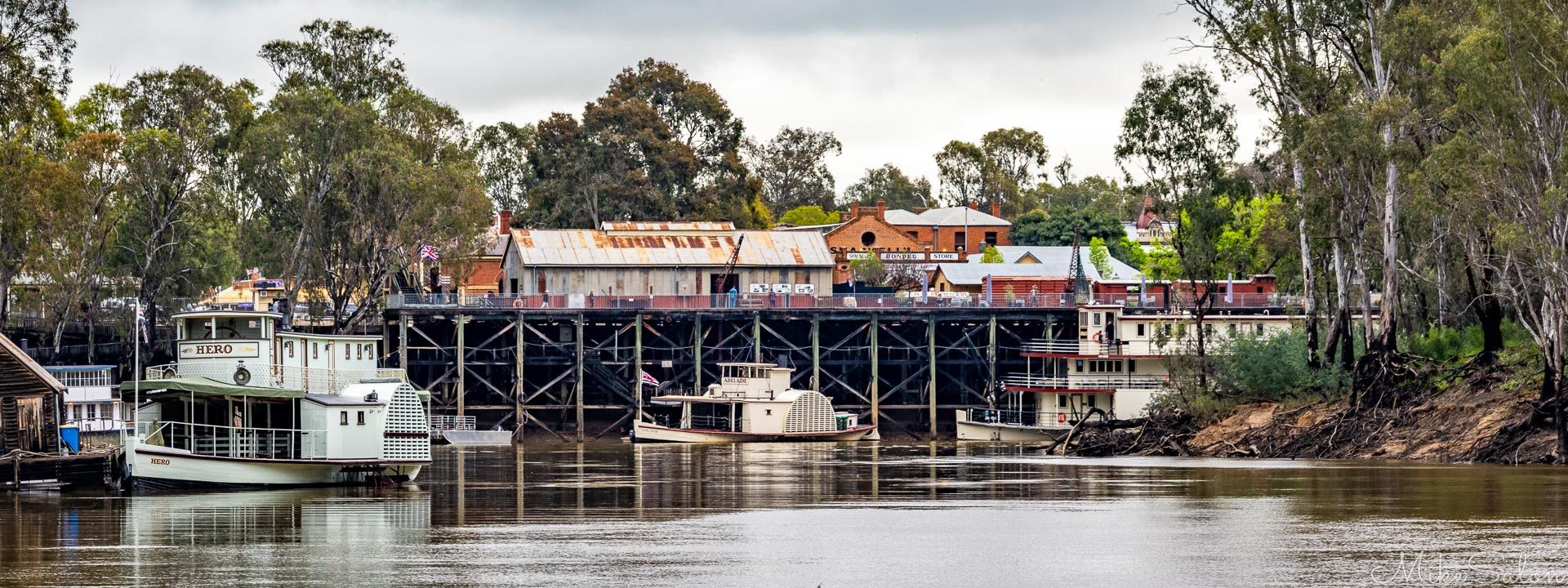
Echuca is one of the few places where Australia's riverboat era is not merely remembered but still visible. Paddle steamers rest against the towering wharf, heritage port buildings line the riverbank, and the Murray flows past much as it did when this was one of the busiest inland ports in the nation. It is a scene that immediately explains why Echuca draws visitors from far beyond the river country. [4585]

mikesalon.com

Melbourne's closest river port...

Echuca VIC

Echuca is one of the few places where Australia's riverboat era is not merely remembered but still visible. Paddle steamers rest against the towering wharf, heritage port buildings line the riverbank, and the Murray flows past much as it did when this was one of the busiest inland ports in the nation. It is a scene that immediately explains why Echuca draws visitors from far beyond the river country. [4585]

Echuca is a busy town! Situated on the Murray River at the closest point that Melbourne comes to Australia's great inland waterway, it enjoys a strategic position that has helped it prosper for more than 150 years. Home to around 15,000 people, the town has been growing steadily, increasing its population by almost 10% over the decade to 2021 while many smaller country towns have stagnated or declined. The result is a regional centre with a noticeable sense of confidence and activity, underpinned by tourism, agriculture and its role as a service hub for the surrounding district.

Part of Echuca's attraction is "no though traffic". Although the town sits at the junction of the Murray Valley Highway (B400) and the Cobb Highway (B75), through traffic no longer has to funnel across the historic Murray River bridge linking Echuca and the NSW town of Moama. In 2022 a new Dhungala Bridge opened, carrying highway traffic west of the town centre and dramatically reducing congestion in the CBD. After serving as the sole river crossing for more than 140 years, the heritage road-and-rail bridge remains in place near the Port of Echuca precinct, now freed from much of the heavy traffic that once rumbled across its deck.

Rise and Fall of the River Port...

Echuca is all about the river and the port. The north end of Hare St is where the town's history comes alive in the form of the Port of Echuca. This is the real magnet for tourists. The Port of Echuca began as one of the great river gateways of colonial Australia — a bustling inland port where paddle steamers hauled wool, timber, and supplies along the Murray–Darling river system. In the late 1800s it was the busiest inland port in the country, its long timber wharf stacked with cargo and alive with riverboat crews, merchants, and railway workers. Echuca thrived because it sat at the meeting point of river transport and the expanding Victorian rail network, becoming a vital link between remote pastoral stations and Melbourne's markets.

Unfortunately, Echuca's glory days were not long lived. Its decline came swiftly when road and rail transport eclipsed the river trade. By the early 1900s the wharf quietened, the paddle steamers dwindled, and the once‑booming port slipped into disrepair. Buildings weathered, the wharf sagged, and Echuca's riverfront became a dilapidated relic of a vanished era.

Fortunately, what followed was one of regional Australia's most successful heritage revivals. It took 50 years to get going, but beginning in the 1970's, the historic wharf was restored, its timber structure rebuilt to original specifications. Surrounding warehouses and sheds were rebirthed as museums and interpretive spaces, telling the story of river commerce and paddle‑steamer life. The old railway depot became part of the precinct's historical fabric, anchoring the connection between river and rail that once defined the town. Even the decision to retain a dirt road threading through the port area adds a layer of authenticity, giving visitors a tactile sense of late 1800s Echuca rather than a polished theme‑park version.

Today the Port of Echuca is a major tourist draw — a living heritage site where restored paddle steamers again cruise the Murray, ferrying visitors now instead of goods. The town's past glory has been transformed into a vibrant cultural asset rather than a forgotten chapter.

Downtown...

Echuca is a place which knows how to cater to visitors. The main drag High Street is replete with pubs and cafes and restaurants, mostly on the west side, with camping and craft shops, ice cream too, on the east side. Parking is free. More serious shopping, likely to be used by locals, is in Hare St where parking meters discourage casual visitation. That must have been an interesting and likely controversial decision by Campaspe Council.

One of the pleasures of visiting Echuca is simply wandering around town. In an era when many country centres struggle with vacant shopfronts and dwindling foot traffic, Echuca's main streets remain lively and engaging. The footpath cafés were doing a steady trade, independent retailers offered more than the usual chain-store fare, and there was enough variety in the shop windows to keep me reaching for the camera. As dusk approached and the warm glow of interior lighting spilled onto the streets, the town took on an especially inviting character. It reinforced a belief I've mentioned elsewhere: if a town wants visitors, it needs businesses that are open and interesting enough to tempt people to stop, explore and spend a little time there. Echuca seems to understand that better than most.

Tourism studies over the past two decades consistently show that Echuca (including its cross-border neighbour Moama) draws the majority of its visitors from within Victoria, especially from regional centres and the northern suburbs of Melbourne. At 3 hours from the CBD, Echuca is a possibility for day‑trips for Melburnians who are motivated by heritage tourism, food and wine, or river cruises. In practice, most Melbourne visitors turn it into overnighters or weekend stays, which is why accommodation has become such a strong part of the local economy. A smaller but significan fractiont of visitors here come from regional NSW, like Riverina towns.

Scenic Drive...

Always hoping for birds, I explored the Scenic Drive of Echuca. It must have been a drive in the past (probably before the elevated town bypass was built), and it is still so named, but these days it is a 4 or 5 km walking trail along the edge of the Murray River, then the Campaspe River, all to the west of the bypass. It's a very pleasant, dead flat walk popular, I found, with morning joggers, bicycle-riders and one or two dog-walkers. There's a nice spot where you can see the confluence of the two rivers. I entered the track at the end of Crofton Street, which brings you out under the freeway.

Silo and Mural Art Trail...

Once stationed in Echuca, we did a 200km+ drive in a loop to the south and east, with the purpose of seeing painted murals on building walls and grain silos. Many towns have become tourist attractions solely because of these artworks, and they may stem the decline which seems to afflict many regional centres. Our first stop was Picola (pop: 65), and it looks like the painted silo there was rather too late to rescue this town. Picola today feels more like a near-abandoned hamlet than an active community, the pub looks to be open but nothing else we could see. Its name is believed to come from the Pikkolatpan people who lived here. In the 1890s, the town sported two churches, two blacksmiths, a bootmaker, a butcher, a brickmaker, a dressmaker and a store, according to a plaque in the street. For as long as it lasted, Picola was nominally connected to the town, but thanks to a sawmiller's lobbying, the station was way out of town, and was doomed to decline.

Then Kyabram (pop: 7,331), which was a bustling town in its own right, where we bought a sandwich lunch at a bakery. Kyabram remains a strong service centre for the district, with a substantial main street and active local businesses. To the west, we then stopped at Tongala (pop: 1,926), a town which, with manifest clear pride, has decorated itself with murals up and down the main street. Some, like those at the pub and the RSL Club, were particularly impressive, and this town is really worth a visit. Tongala's war memorial is focused on the Vietnam conflict. It was a Saturday, but the town seemed very quiet with nothing much open. In Stanhope (pop: 822) to the south, we found one very wide monochromatic mural on the cheese factory; its name, appropriately we think, was Legendairy. Stanhope is a small dairy‑industry town with a modest but tidy commercial strip.

Then Colbinabbin (pop: 315), which hosted a magnificent montage across five adjacent silos, truly very impressive. Colbinabbin has tried to reinvent itself around its silo art, drawing visitors who would otherwise pass straight through. It needs to try harder, with only a few businesses open to attract visitors and seperate them from their money. The Colbinaabin pub, under new ownership we heard, is setting itself up in this regard, positioned with a view of the silos and running an efficient kitchen with a better than average pub menu.

Our final stop on the loop was Rochester (pop: 3,154), mid Saturday afternoon, so very quiet except for the pub. We found two muraled silos near the railway station blessed with fabulous artwork of local critters, and others scattered through the town and along an arcade of artworks by locals. Rochester remains a significant rural town despite the effects of recent floods, with a well‑defined town centre and strong community identity.

Huge grain silos and water tanks are a perfect canvas for giant murals, and they visibly add to the appeal of towns which have little else to attract visitors. Several have clearly discovered this secret, but they also have to market themselves and have businesses open (like cafes) which could encourage travellers to dwell and spend.

Acacia Terraces...

We were to stay four nights in Echuca-Moama, so we looked for somewhere more comfortable and spacious, and found it in Acacia Terraces, a block of four north-facing single storey one-bedroom Victorian terraces built 25 years ago at the back of the owner's house, a faux-Georgian mansion (of the same age, we think). Our terrace was very comfortable with plenty of room in all spaces. It was showing its age, however, with what look like mostly original furniture and appliances, a cracked and chipped tiled floor in the living/kitchen room (no rugs) and worn carpet in the bedroom. The reverse-cycle air-con was very effective, and the bed had electric blankets. There was a well equipped kitchen, a top-loading washing machine and a spin-drier, and a walk-in wardrobe. For us, the indoor spa was a waste of space and the bathroom would have been better with a larger and more modern shower, and some horizontal real estate beside the vanity. For anyone with lots of devices to charge, the terrace was very well equipped with power points. Any property adorning itself with the "luxury" adjective needs a better, not just bigger, bathroom, and decent amenities. That grumble done, the water was hot, the shower didn't leak on the floor, and we were provided with two full sets of towels each. There was a ceiling heat-lamp in the bathroom, a feature missing from many more up-market accommodations. The living and sleeping areas wrapped around a tiny but private courtyard which was great for letting light in. Parking was right outside the door, at the end of a pebbled driveway. The room "compendium" (itself a rare sight, these days), contained good information but everything about local attractions, services and events was a year out of date, a lazy omission. The front door was equipped very poor security (a basic residential push-button lock) but we were in a very quiet part of town, in a dead-end street. The co-owner, Sharon, met us on arrival, and gave us a detailed tour of the terrace, after which we never saw her again. This review may sound overly critical, but in fact, the Terraces were competitively priced and were very good value for money.

We had no trouble getting breakfast and good coffee in the mornings. My Dad's Honey had a pleasant outdoor courtyard, but our favourite proved to be Odd Captain run by a gruff fellow, probably the odd captain himself, and a capable crew. There was neverending entertainment because this cafe was on a roundabout where all the vans exiting the caravan park would pass. While the Echuca Hotel had an irresistable apple crumble in the evening, we took to Bar-Lee, a distillery with a self-evident name, whose meals were interesting and small, a perfect combination for us. Bar-Lee's spirits were good too: their single-malt whisky ws neither Scotch nor Bourbon, but excellent.