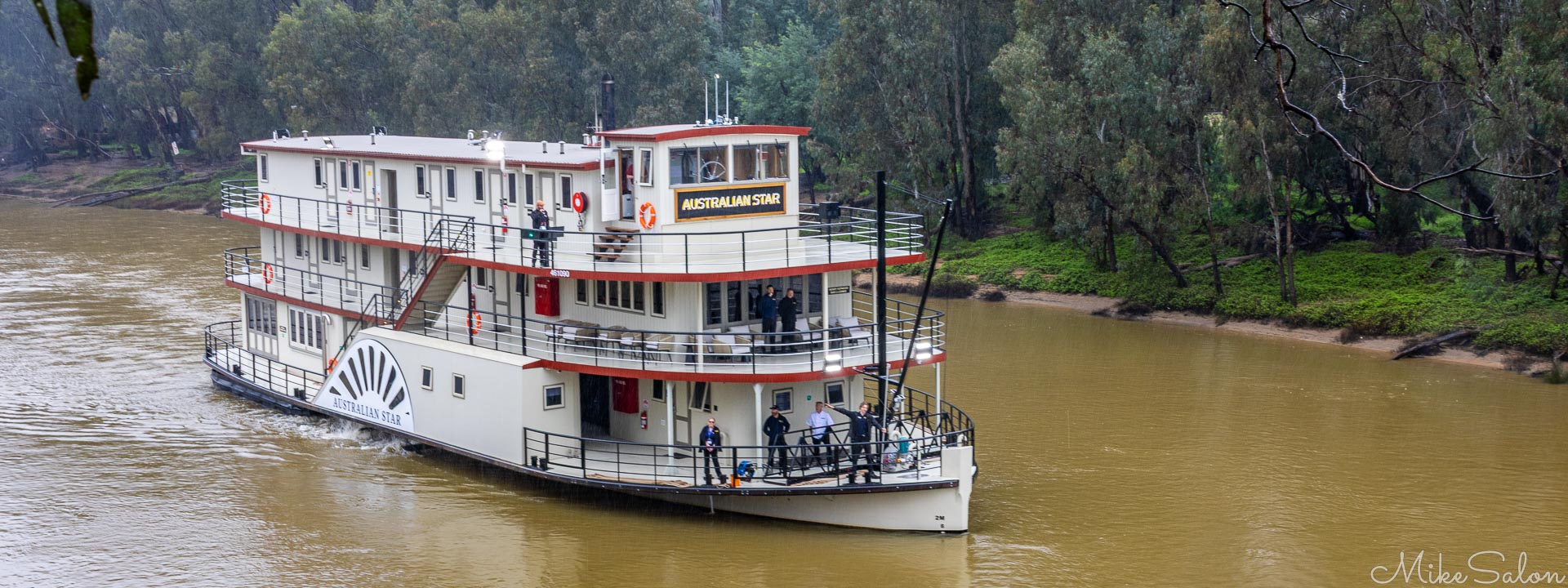

Our voyage on the PS Australian Star was between Torrumbarry Wier (1579km upstream from the river mouth at Goolwa SA) and the Port Of Echuca (1620km), not a great distance by any accounting. In river kilometers (which can be read from blue signs nailed to trees) the total distance is 41km. Over that stretch, the river basically follows a wobbly straight line, and the "crow-flies" distance is only 32km. It's hardly an epic journey when the entire route fits inside a 16km radius circle! But we spent a week doing it at the slow cruising speed of a paddle-steamer, allowing also for extended stops at points of interest and being moored overnights. This was very gentle travel! We embarked and disembarked at Torrumbarry, so it was a return trip!
PS Australian Star
The construction of the PS Australian Star appears to be a joint enterprise between Murray Valley paddle-steamers (MVPS) and APT (from Australian Pacific Touring). It is a brand new vessel but built in the spirit of the Murray River's 19th‑century steamers and was constructed in Mildura over many years involving dozens of regional craftsmen and specialist suppliers, her design blending traditional riverboat architecture with contemporary comfort and technology. At her heart sits a refurbished 1907 wood‑fired steam engine, giving her an authentic working heritage despite being a newly built ship. On completion, she has become the largest paddle-steamer in the Southern Hemisphere and the first to claim to offer five‑star overnight cruising on the Murray.
After her hull launch and an arduous 750km upriver paddle to Torrumbarry for final fit‑out, the Australian Star was formally christened in early 2026. Although earlier commercial voyages had been scheduled, the ship proved to be not ready with some serious but undisclosed technical problems needing resolution. Passengers on cancelled voyages were moved to later sailings (where possible) and several of our co-passengers were in this category. To our good luck, the actual maiden sailing was the very one we booked on! So her true debut came with this voyage — the first to carry paying passengers. This marked the moment she stepped fully into her intended role: a steam‑powered river vessel reconnecting travellers with the Murray's history while opening a new chapter in Australian river cruising. As maiden voyage passengers we were honoured for the privilege, but on the other hand, suffered from the effects of many teething troubles as the crew figured things out. At least the PS Australian Star did not encounter any icebergs on its maiden voyage!
We read that the Australian Star is intended to transform the Murray River into a true multi‑night cruising destination comparable to the Rhine or Danube. Even allowing for the absence of castles, this seems a very ambitious goal! Public spaces on board honour river pioneers. The Hopwood Lounge & Bar is named for Henry Hopwood, founder of Echuca. The Randell Dining Room is named for William Randell, who launched the first Murray paddle-steamer in 1853.
The Australian Star takes 38 passengers in 19 cabins (there were 36 for our trip) and 10 crew (we didn't see that many). We are grateful that the boat was not 100% full. The dining room (Level 0 aft) was packed with 36, too tight for for the waiters to navigate easily. The other common room on the boat, the bar (level 1 bow), was overloaded with this number too!
The Australian Star's story is both a tribute to the past and a new beginning. She stands as a contemporary continuation of the river's paddle-steamer tradition, reimagined with modern engineering, heritage craftsmanship and a deliberate respect for the culture of the Murray. We, as passengers on her inaugural commercial sailing were proud to be part of the very first page of that story. Being maiden voyage passengers, we were pleased not to encounter any icebergs, but the shallow, narrow and perennially muddy
The Mighty Murray...
The Murray was first crossed (by Europeans) in 1824 when they were pushing south, but they only called it "a fine river". It was named in 1830 by explorer Charles Sturt (who navigated it in this area) after Sir George Murray, the British Secretary of State for War and the Colonies — effectively honouring his political boss in the classic style of colonial patronage. Murray was a career soldier turned cabinet minister, influential in shaping early colonial administration but he never set foot in Australia. Today, the river is better understood through its First Nations identities, with names such as Dhungala, Millewa, and Murrundi reflecting the many Aboriginal languages and Countries along its course.
In the late 1800s, the Murray–Darling paddle steamer trade was regularly crippled by low river levels, with boats stranded or isolated for months at a time. To stabilise navigation and support irrigation (but disturbing nature), the SA, NSW & Victoria agreed in 1915 to a major program of storages, weirs and locks, and most of the Murray works were built between about 1919 and 1935. The original plan envisaged 26 locks and weirs up to Torrumbarry, but only a subset was ever completed: many were abandoned as river transport declined in favour of rail and later road. Torrumbarry Weir and Lock, designated #26 from the original plan and finished in 1924, is one of these completed works, and when the Australian Star steamed from Mildura to Echuca she passed through it, relying on favourable seasonal river levels rather than the fully continuous navigation system that was once imagined.
The last significant flood on the Murray was in 2022, quite recent, and it left a deep mark on everyone who lives along the river, certainly all those we encountered. Between November 2022 and February 2023, the Murray rose to levels not seen since 1956, with flows at the South Australia–Victoria border peaking at 186GL per day. Thousands of homes, shacks and farms were inundated, levee banks were overtopped, roads and ferries were shut down, and whole communities were temporarily cut off. The flood also reconnected wetlands and floodplains that hadn’t seen water in decades, flushing salt, reviving red gums, and triggering a boom in frogs, fish, turtles and birdlife across the system. It was a disaster and a renewal at the same time — the kind of event that becomes part of local memory, retold every time someone points to a flood gauge and says, "That was 2022."
We have discovered that the Murray River is a bounty for photographers. To see it was a big surprise to us city dwellers whose experience with water is mostly the ocean and the harbour. We expected quiet and solitude, maybe even wilderness, but the river was a hive of activity, which increased in intensity the nearer to Echuca and on Friday, but it was strangely quieter on the weekend. Development along river was likewise tapered, with everything from large manicured estates to the most primitive of campsites. Houseboats full of families and party-goers cruise along, and moor up at seemingly random places along the riverbank. As far as we could see, rented houseboats can moor anywhere they like as long as there is no (always obviously private) infrastructure there. Some boats were moored in what looked like dangerous locations around blind corners. Kids played on the waters edge, and bigger kids raced speedboats and jet-skis along the river
It was fascinating to learn that the stretch of the Murray River we traversed is "new" in geological terms having been created by a series of powerful earthquakes a mere 45,000 years ago. A long ridge of land lifted about 10-15m near Mathoura, upstream, forcing the flow to spill southward into new territory. The modern Murray through Moama, Echuca and downstream toward Torrumbarry is the result of that diversion — a younger, rerouted channel carved as the river searched for a way around the uplift. Cruising this stretch today, the tight bends, dead‑end anabranches and stranded side‑channels remain visible remnants of that seismic event.
From dawn's quiet reflections to dusk's golden calm, the Murray reveals every facet of its character — a river of contrasts and companionship. Here, life unfolds along its banks in all forms: solitary camps and family laughter, heritage vessels and modern speed, the timeless rhythm of water shaping leisure and livelihood alike. The set below traces that continuum — from the simplest encounters to the most luxurious moments — capturing the river as both playground and passage through Australia's enduring heartland.
Aboard PS Australian Star...
Our crew was Captain Scott and first mate Andy. The hotel team consisted of Paul and Julie. The kitchen chef was Cameron (?) and a small team we never saw. The entire crew were great, but the star was a young tall man called Logan who ought to win the APT staffer of the year award. He was a runaround on the boat crew, never idle, and joined the hotel team at mealtimes. He manned the bar, swept the decks, tidied the ropes and clambered ashore to secure them. He still found time to give us personal service, with a sense of urgency and a smile, but no expectation of a tip.
The Tour Leader was Michelle, a mature-aged lady with a lot of experience, but even she struggled with the teething problems on board PS Australian Star. She worked well with all the passengers and crew, and we don't know when she slept. Another crucial MVPS staffer was Ross, the bus driver, at every stop, and in between bus trips he delivered odds and ends to the boat at every port of call in a ute. (Don't forget, this entire journey was within about 45mins max of Echuca!)
Other passengers (36 in total) grumbled about their cabins, mostly that they were too small, but we had no such cause for complaint. We had the King Suite, twice the size, on the top deck at the stern, with a private balcony. We no doubt paid handsomely for this cabin which we deliberately chose to accommodate our bulky luggage and technology - we don't know how to travel light! All cabins had televisions, with channels offering the usual fare on cruise ships: promos for the operators, a real-time map, and a forward view camera. There were also about 90 "broadcast" channels available, all of them showing rubbish repeats of ancient American TV shows. We suspect that this unsatisfactory offering is bundled with the ship's Starlink subscription which provided us with excellent broadband but lousy television. This is surely a fixable problem.
We are prepared to accept that there were going to be teething troubles on the maiden voyage, and there were. Most were trivial and affected supplies and service only in a minor way, but two major hangups were that the steam engine was basically inoperable, awaiting some modification, so we motored the river with a diesel engine operating the paddles; and also that the lift was also down and out, awaiting some expert servicing, which severely inconvenienced some less mobile passengers on this three storey boat. We are glad it was not us who had to lug our baggage up two flights! The lift was brought into action halfway through our journey. The staff themselves were faultless, dedicated to their tasks and friendly. The dining experience was not as good as we could have expected, given what we were paying and led to expect. Appetisers, entrees and desserts were excellent, and looked good too, but some mains left us wondering. There seemed to be little flexibility in the kitchen. Maybe the chef is still developing relationships with his providers, given this was a first voyage under the fire of demanding customers?
The PS Australian Star never sailed far into the night. You can't take in the scenery in the dark! Out seven days were spent either paddling along the river or on "experiences" from the paddle-steamer's moorings. Most of these involved a coach trip to somewhere near the mooring, and that was always in the same coach with the same driver, Ross. How else would you do it, given the tight cruising range along the river? The coach, apparently newly bought by MVPS and transported to Echuca-Moama by driving it from Cairns, had a rated capacity of 40 which means. This exactly matches the full passenger compliment of the Australian Star plus the tour leader and maybe a guide, but it was too crowded when full, and a bigger bus would be more comfortable.
A Passing Parade of Aussies...
No wildlife expedition ever took place on this journey. There were no elusive rarities, no species ticked from a list, and no frantic searches for something exceptional. This was not a twitchers outing. Instead, the photographs in the set below record the wildlife that simply shared the Murray with us. A pelican gliding past the boat, a heron waiting beside a fish ladder, a pair of swallows briefly pausing from their aerial acrobatics, a cockatoo inspecting visitors from the entrance of a tree hollow. Individually they are familiar creatures; collectively they form the living fabric of the river. The Murray's greatest wildlife spectacle is not found in any single species, but in the abundance and variety of life that accompanies a journey along its waters.
Torrumbarry Weir...
We first boarded the Australian Star at Torrumbarry, becoming the first paying passengers to occupy the ship. We departed the paddle-steamer at week later at the same place. Goulburn‑Murray Water (GMW) operates and maintains Torrumbarry Weir and Lock under the direction of the Murray–Darling Basin Authority (MDBA).
As usual with dam facilities all over Australia, the nearby landscape is manicured, and also there is an excellent visitors with much interpretative information facing the weir. The 1924 facilities at Torrumbarry degraded over the years and a rebuild was opened in 1997 next door consuming the original lock andf weir's picnic area.
We could wander freely over much of the weir, but skipper Scott also took us for a guided walk. Not only is he a master of river shipping, but also an expert at hydrology and the Murray-Darling river management scheme. His presentation as we walked around with him was both informative and entertaining. And amazing too, when we learned that between Echuca and Torrumbarry, the Murray flows through one of its flattest reaches — its a broad floodplain where the river's fall is barely 3cm/km. This minimal gradient means water moves slowly, spreading laterally rather than dropping steeply downstream. In flood, local tributaries like the Campaspe and Goulburn pile water into the channel, flooding Echuca, while, downstream, Torrumbarry's wide weir pool absorbs the surge with little change in height. The result is a river that seems almost idle, yet carries immense volumes through its shallow descent — a defining but amazing feature of the Murray's lowland hydrology.
Perricoota Station & Murray Gums Estate...
The Australia Star moored at Perricoota Station
Then a coach ride to Murray Gums Estate
Layfield Lane...
After a day of paddling on the outbound sector we paddled into what the Australian Star crew called Layfield Lane on the NSW side. We came back to this mooring for an overnight on the backbound sector. MVPS leases part of the property here from the new owner for their exclusive use, which means Australian Star and PS Emmy Lou. That'd be 4 nights a week by my calculations. We assume Layfield Lane is the property name, it being located on Layfield Road, Moama. We talked to the owner who explained the lack of a crop with "the departing owner didn't plant anything". He plans to sow canola, probably, next year.
Our waterfront section was an extremely pleasant spot (except for the flies). We were able to walk along the long driveway to the property and along Layfield Road. Long tables and chairs set out, an open fire for the chef to mount a barbeque. The open fire made us warm and cosy as we sat around it after dinner to enjoy live entertainment both nights we stopped here: local performers we assume, appreciating a paid gig.
Echuca & PS Pevensey...
An old steam-powered paddle-streamer, Pevensey
We wondered why, having motored for days on a paddle-steamer, our experiences while at Echuca were to include an hour's cruise on the Pevensey. Well, it was first meant to be on the MVPS owned PS Canberra but as reported by Riverine Herald in Shepparton News
The Pevensey has another claim to fame, in that it was featured (branded as PS Philadelphia) in the 1983 four-part TV miniseries All the Rivers Run starring Sigrid Thornton and John Waters. Wikipedia says "All the Rivers Run follows the life of English girl, Philadelphia Gordon, from the time when she is shipwrecked and orphaned off the coast of Victoria in 1890. She spends most of her life around Echuca, on the Murray River, and invests some of her inheritance in the paddle steamer called PS Philadelphia". Rumour on the Australian Star was that they plan to run this mini-series on the boats TVs, when they get the DVD and figure out how to play it.
The other riverboat offering regular cruising around Echuca is the colourful PS Melbourne. Since this boat and the Pevensey cross paths frequently every day, they amuse each other, and the paying guests on board, and the onlookers on Echuca Wharf with musical tooting from their respective steam whistles. The Melbourne takes on its passengers in Moama, near Horseshoe Lagoon
The bus trip (Ross again, naturally) took us to the towns of Rochester and Colbinabbin to see the water-tank or silo art. We had lunch at the Colbinabbin pub which, despite the town being so quiet, was very busy at this time of day. Including us, they must have had 70-80 patrons in for lunch, fed by a very efficient kitchen. New owners, we heard.
And the night tour was Port After Dark, a one hour lantern (battery powered LED simulations of old kero lamps) lit walk around the port area where we could "step into the shadows of a turbulent past, where tales of greed, murder and betrayal ... fuelled decades of mystery, legend and local lore" (according to the brochure). Here, the dedicated enrobed guides took us past closed shops, down narrow arrays (complete with ghost stories) and into the mysterious basement (with a secret smuggling tunnel) of the Ship Inn. Built around 1864, the Inn served a bustling wharf precinct where paddle‑steamers unloaded wool, timber, and supplies for transport to Melbourne. It catered to river crews, merchants, and travellers drawn by Echuca's rapid rise as Australia's largest inland port. Its sturdy red‑gum construction and proximity to the wharf made it a fixture of the port's social life — a place for news, deals (some nefarious, by the sound of it), and hard‑earned refreshment. After the river trade faded with the advent of rail, the Inn survived, and was later restored. Today it remains an operating pub. Our tour went past its beer-drinking clients, who largely ignored us.
Deep Creek Marina ...
We moored at Deep Creek Marina on our second night outbound from Torrumbarry, arriving early evening. Deep Creek is a commercial establishment on the NSW side with a hotel, cabins and mooring for hundreds of houseboats in a river meander remnant
Our bus, manned by Ross, took us to the Great Aussie Beer Shed and Heritage Farm Museum
Why Side-Paddlers on the Murray? ...
All the functioning, retired and derelict steamers seen on the Murray River were "side-paddles", which posed the question about how the nautical engineering decision is made between side and rear paddles, and indeed propellers. We asked Captain Scott. Nearly every historic steamer on the Murray is a side‑paddler because that design suits the river's tight bends and narrow channels. Side wheels can be driven independently, giving the boats remarkable manoeuverability — they can pivot almost on the spot, an essential trait on the winding stretch between Echuca and Torrumbarry, which is exactly what we saw them do when undertaking u-turns. Stern‑wheelers, common on the Mississippi, offer a shallower draft but far less steering finesse. Propellers are efficient but vulnerable to snags and require deeper water than the Murray once provided. The river's shape dictated the engineering, and the side‑paddlers of the Murray are the legacy of that practical, river‑driven design tradition.